Day 2 of the 2024 Nonprofit Technology Conference is in the books and I’ve got notes!
These are informal and rough, taken during the sessions. My goal is to capture the spirit of the presentation and the best quotes and bits of wisdom. If you see something and you want me to share more, leave a comment!
Keynote
Sabrina Hersi Issa, Be Bold Media
Definitions belong to the definer. Not the defined.
Toni Morrison
Sabrina started as a programmer and found that role was rooted deeply in capitalism (more signups!). She didn’t want to capitalism define her work as a technologist. She decided to be a “Human rights technology” who applies “justice frameworks to technology.” Instead of centering growth and profit, she centers values.
We are in defining times in technology, notably around AI right now. Even when we talk about “ethical AI”, “AI” is what’s centered, not the needs of people/humanity. we should ask:
- Who defines what is ethical?
Who defines what is humane? - Who defines responsibility?
- Who holds the keys to accountability?
Incrementalism will not deliver liberation.
Sabrina Hersi Issa
Solidarity technology. We should use our technology to be a force for collective humanity. It can expand (think abundance).
The most-impacted are not the ones who should be most burdened. That is not humane and is not in solidarity.
The only way to counter systematic exclusion through systemic inclusion.
Sabrina Hersi Issa
- How you create informs what you create.
- Your process determines your product.
- Reframe dominant narratives to reposition power.
Solidarity is practicing possibility upon imperfections.
Sabrina Hersi Issa
How we choose to use our power tells a story about us. What story does your power tell about you?
Liberatory Innovation: Abolitionist Approaches in Tech
Nick Okafor, trubel&co and Maia Woluchem, consultant
Collaborative Notes for Liberatory Innovation
“What is radical imagination?”
We did an activity of “Yes and, what if” around housing (“What if we didn’t have to pay rent? Yes, and what if…?”), labor and food. It’s an activity about dreaming big and envisioning “north stars” that we can work to over years.
My notes are sparse because I spent quite a bit of time participating and chatting with a small group about how we use tech and data.
Abolitionist Strategies
What does “abolition” mean (leaning on Mariame Kaba’s definition):
- A constant becoming
- A political vision, a structural analysis of oppression, and a practical organizing strategy
Abolition is a process. We have to believe that any system can be changed by expanding the bounds of what we think is possible.
Case Studies
Brooklyn landlord does an about face on facial recognition plan
Tenants of a rent-stabilized building were told their building was replacing doorbells with facial recognition. It seems likely that the landlords did not consider or honor thoughts on what people who live there would think or how they’d be impacted. Problems with the approach:
- Facial recognition struggles with darker skin tones
- Who will have access to these images and ata? (The police?)
- Me: How do you manage consent by visitors? Minors?
What happened: The tenants fought back, sued, and the landlord backed off.
For more, see Landlord Tech Watch.
Healthcare algorithms
An algorithm was built to try to find chronically ill and high-risk patients within the healthcare system. They used “healthcare costs” as a proxy for this, without considering that Black and brown folks have higher insurance costs and access the ER more.
How could we approach this differently? Have folks from impacted communities develop the algorithm.
GIS: EJ (Environmental Justice) Screen Geospatial Mapping Tool
This was created to combine demographic and environmental data to highlight inequitable environmental impact on communities. It’s very important to always think through the underlying data. The history of redlining shows us the ways mapping can be used for discrimination.
If you open this tool and explore your community, what do you see?
Things we wished our white colleagues knew
Dani Faulkner, Tristan Penn, Bettina Sferrino
Collaborative Notes for Things we wished our white colleagues knew
The purpose of the session was to get the NTEN BIPOC community “more free”. And importantly, that community is not monolithic. I’m specifically appreciative of the emotional and logistical work the three presenters put in to creating and sharing this presentation.
The stories shared in this presentation were not intended to be shared outside the room. The lessons from the stories are what should be learned from and appreciated. And importantly, these stories may sound extreme to white folks, but they are not extreme. They are normal.
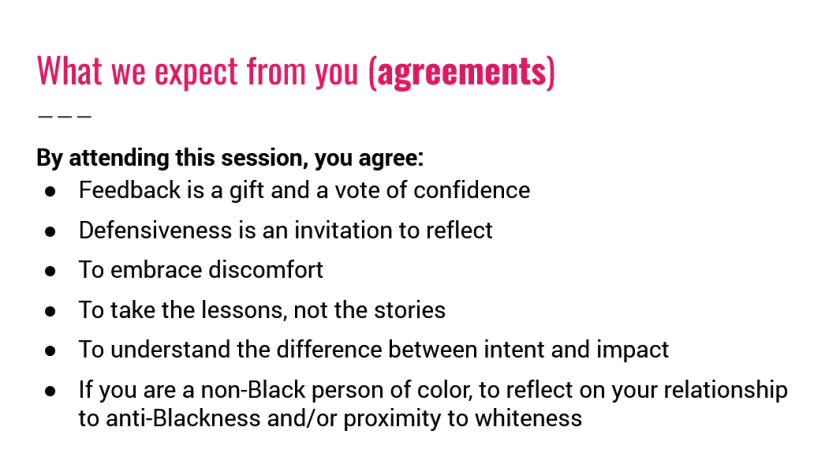
- There is a difference between comfort and safety. Recommended article from Ijeoma Oluo. When you have privilege and power, discomfort can feel unsafe. Discomfort is not safety. This logic can also be turned around on POC who are made unsafe and told they are just uncomfortable.
- Yes, racism happens here. “Here” means NTEN and our organizations. If you think “racism doesn’t happen here”, then reflect on your lens. Do your colleagues feel safe to speak up? (Often they don’t.)
- We do not owe you proof. People share their stories with you as a gift to help you (at their own risks and effort), not to have their story repurposed and weaponized to affirm or validate white people.
- Microagressions don’t mean micro impact. Not sure what a microaggression is? Let me help you! One particular example is “microagressions as compliments” (back-handed compliments with pernicious racial overtones). “Death by a thousand papercuts.” From Ijeoma Oluo’s So you want to talk about race?, “if you get elbowed by 9 people and a 10th person accidentally nudges you with their elbow, it’s not unreasonable to get mad at that person.” See Nonprofit Boss Life.
- How/that you are tokenizing us. Be honest about the diversity of your organization and not lift up a single person to “prove” how diverse an organization is. Don’t celebrate people only during “their [identity’s history] month.”Recognize and consider the amount of effort it puts on a person to speak up if they’re being tokenized.
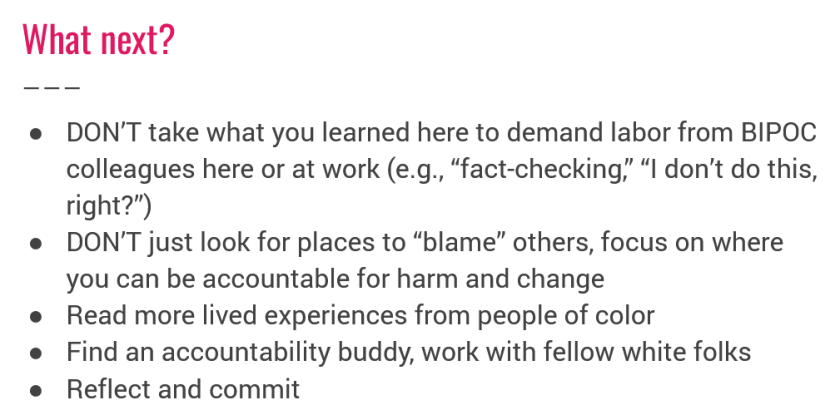
- You cannot make BIPOC responsible for your organizational development and growth. Don’t make BIPOC run diversity initiatives or speak “on behalf” of their groups. See “The ‘problem’ women of colour in nonprofit organizations”. Similar to white people needing to educate themselves, white people need to invest, research, and plan DEI projects without throwing them at BIPOC.
- We are exhausted. The exhaustion of dealing with all of the other things listed here is on top of all the exhaustion we are all facing dealing with the Pandemic, capitalism, etc.
- We are full, complex people just like you. And yet we have work places that make BIPOC uncomfortable bringing them full selves to work. We must make our spaces safe and acknowledge the humanity of everyone.
- Being anti-racist requires leveraging your systemic and positional power. Speak the names of BIPOC in rooms of power. Call out the contributions of BIPOC in public. “Antiracism is a verb, not a belief.”
Critical point: Everyone makes mistakes. What is important is trying, making mistakes, taking accountability, and cleaning up your messes.
WordPress Community Meetup
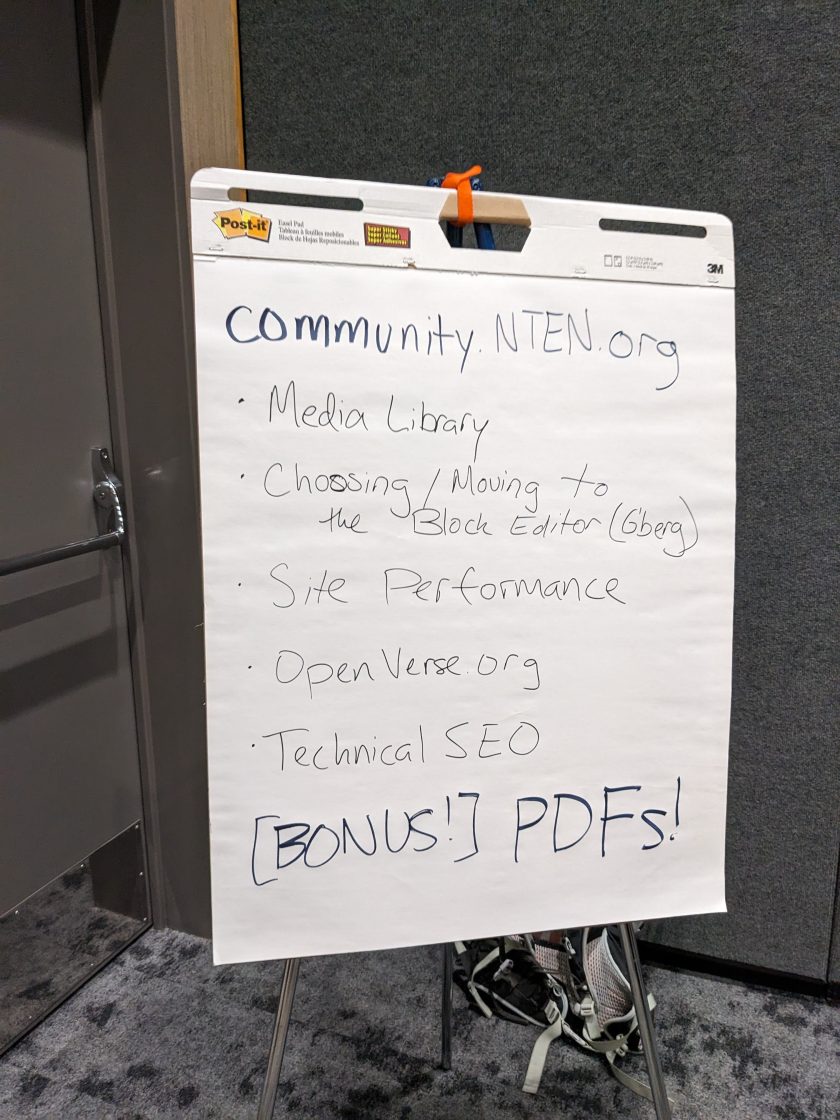
We ended the day with a great conversation with the NTEN WordPress community (free to join!). After we all introduced ourselves, I quickly facilitated a session of “lean coffee”, where people write ideas on post-its, allow folks to vote for their favorite sessions, and then talk through the list in order. We talked about SEO, site speed, the block editor, managing an bulky media library, and how we all don’t like PDFs. It was a great community discussion and makes me excited for our next community call!