I’m at the 2024 Nonprofit Technology Conference and so are my field notes!
These are fairly informal and rough notes I take during sessions (except my own, of course), but I always hope to capture the spirit of the presentation and any key takeaways. If you see something and you want me to share more, leave a comment!
My Presentation: “Test your website’s accessibility starting…now!”
I had a great time helping people kick off their NTC sessions with my own presentation immediately after the opening keynote: “Test your website’s accessibility starting…NOW!”
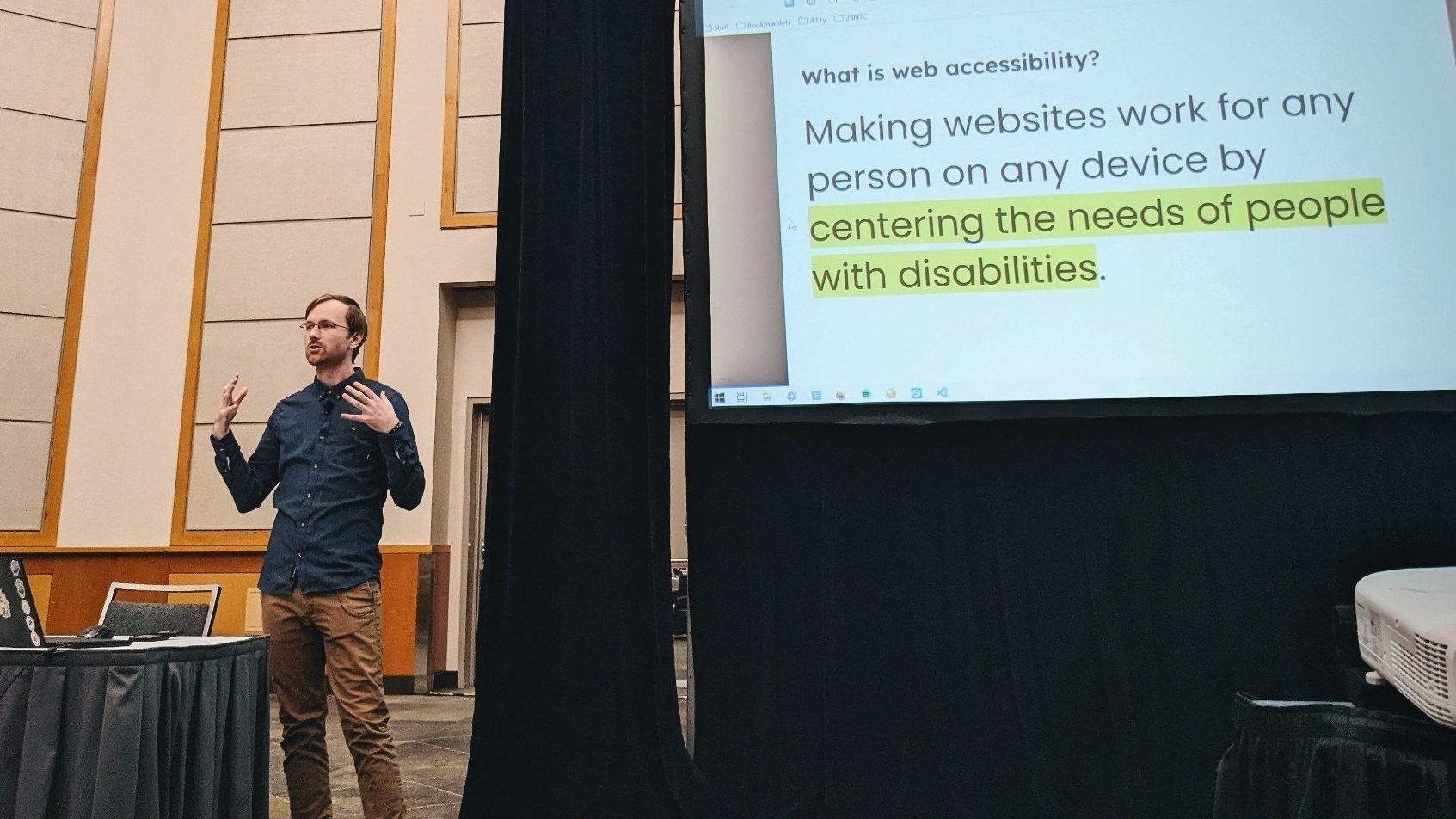
You can find slides, resources, a worksheet, demos, and links to tools all on a page I put together for DIY accessibility testing.
There were about 45 people, and I was thrilled that for a majority of attendees, it was their first time testing keyboard navigation or evaluating page heading outlines. The hands on time was incredibly engaging, and almost everyone left the room with concrete things to fix on their websites! I heard from one attendee this evening that it was so great to go to a session where you actually got to do something. So mission accomplished!
This was the most ambitious presentation I’ve ever given in a lot of ways, and I’m very pleased with how it turned out.
Introducing the AI Framework for an Equitable World
Amy Sample Ward (NTEN), Tristan Penn (NTEN), Toshi Hoo (Institute for the Future)
Equitable AI Framework Collaborative Notes
“AI” means different things to different people.
This framework was created with 30+ organizations and sought to avoid making explicit recommendations about specific tools. The goal was to “ask the right questions” and follow the answers. Toshi called it a “collective intelligence process.”
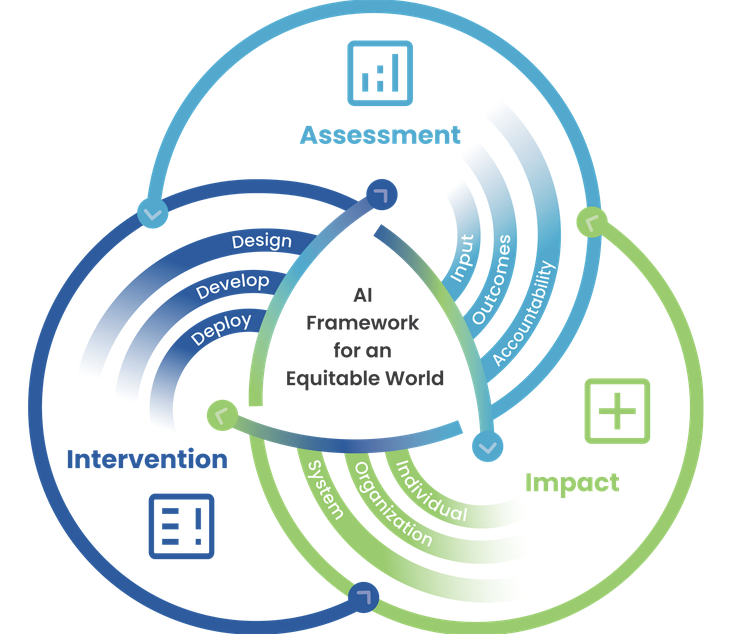
The framework is made of three points that are part of a “continuum”. There is no “great, we did it!” moment, because we need to always be applying the framework and each component influences the other.
Assessment
- Input we give AI for prompting, training data, and people involved in building it determine the…
- Outcomes of using the model which need…
- Accountability for how the model is used.
Super important point about AI: The new AI technologies is “non-determistic”. This is really important and different from older systems because each time you ask the same question, you can get a different response. AirCanada learned this the hard way.
Impact
- Individuals make decisions and have biases and assumptions. They work in…
- Organizations which are made up of individuals who have input on those organizations for accountability and transparency. Together they all work in a…
- Systems which impacts us all.
“Just one person” using AI isn’t just one person. What data are they using or telling the AI? How are their decisions and output used? Who is impacted by another person’s use of an AI tool?
Intervention
- Design is everything from policies to code. They make up the decisions about how and what to…
- Develop the datasets and algorithms that we then…
- Deploy into the different layers of our work.
One thing I like about this framework is how it links individual decisions to bigger systems that impact individuals. We need people to be actively involved in choosing how they use AI tools since the impact will come back to them. When it comes to AI, there is no “just for me” decision-making.
Toshi mentioned using a “futures wheel” for thinking through first-, second-, third-, fourth-, fifth-order consequences.
Amy made a great point that even if we’re making a decision that doesn’t turn out, using the framework is at least a process that you have gone through.
You can’t have an AI policy without a data policy and privacy policy. This work is closely related to the NTEN Equity Guide for Nonprofit Technology.
“We have the plan for the killer robots. We don’t have the plan for the Large Language Models.”
Strategic Team Meetings for Teams of One
Janice Chan, Shift and Scaffold
Collaborative notes for Strategic Team Meetings for Teams of One
When you’re a “team of one,” it’s very easy to think “I’ll just figure it out” and skip over the strategic planning work.
What are meeting good for:
- Making a decision as a group
- Getting input from most-impacted people to make a decision
- When you are co-creating
- Unpacking and debriefing
- Creating space for dialogue
“Meetings are useful when dialogue is essential.”
Effective meetings for individuals:
- Stated purpose
- Scheduled with appropriate time
- Create an agenda
- Identify which “roles” you need to represent (your roles may determine the objectives you’re prioritizing)
- Take notes
- Assign action items and manage the project
Key point: You need to be prepared, informed, and ready to make effective decisions, whether that’s a one-person or multi-person meeting.
Have a calendar to schedule your meetings with yourself (e.g. mid-year check-in). You have to protect your time and prepare yourself to use them well. Strategic work won’t happen if you don’t prioritize it.
“Thinking alone together.” This is a technique from creative writing, sometimes called a “shut up and write.” Get into a group and be silent while you’re writing.
Ways to protect your mental energy and capacity
- Designated no-meeting days
- Regular day set aside for strategic work (think about the best time for you!)
- Manage distractions (notifications, inboxes)
- Do a brain dump
- Go for a walk / move your body / go to a different space
- Consider time of day
It can be good to ask, “What will be lost if we do not prioritize X”, where “X” is “strategic work”. Things that are urgent can easily distract from longer-term work.
Two types of meetings I’m interested in: a project kick-off and project retrospective meeting. My action item is to create the agendas for the meetings I want to have and schedule them as best I can on my calendar so I don’t forget.
For every meeting: determine a purpose. Use different structures. Respect your needs.
Planning an inclusive and welcoming project
Brenda Perez and Josh Kelley from Big Duck
Collaborative notes for Planning an inclusive and welcoming project
There is no absolute answer to this. You need to think about the space and the people who are there with you.
- “Determine your inclusivity metrics, set goals, and track success to start.” Look to values, DEI commitments, etc. when answering this. Some examples of “metrics”: Race, class, and gender. This is about making sure you’re thinking about the diversity of spaces and then seeking to improve beyond that baseline.
- “Made for you.” Be proactive in being welcoming and accommodating. E.g., share a pronouns without being asked, turn captions on by default (or hire a captioner!)
- “Create safer spaces.” Don’t guarantee safety, but make a commitment to always be working toward it and where you are right now. Provide multiple ways to engage. For instance, provide an anonymous feedback form anyone can use at any time.
- “Virtual accessibility is the new normal.” Centering accessibility can be a useful way of managing power differentials among group members.
- “Access, access, access.” Make transparent project update doc that lots of people have access to. Keep this simple and share it widely. Decentralize data, even if not decentralizing decisions.
- “Plan for multiple ways to process and participate.” e.g., People on Zooming being on camera speaking vs. off-camera and in the chat. And when you do this, make sure you’re engaging with all the options. Consider phone calls over video calls.
- “People are more than data.” Be sure to “close the loop” with your commitments. Don’t just extract information people. Come back and maintain a relationship.
- “Name the power dynamics.” Literally. Out loud.
- “Stay flexible. Pivot.” Being welcoming and inclusive means inviting more communities in. This takes more time. Budget and schedule for doing this.
- “Name the labor and celebrate the successes.” It is so critical to acknowledge the work of other people and celebrate accomplishments.
NTEN Online Community Organizers Meetup
I ended my day meeting with seven other online NTEN community organizers. I’m a co-organizer of the WordPress NTEN Community, and I’d love for you to join! It’s free for anyone, and you can participate in our message board and come to our once-a-month community video calls.
Other communities include those for identity groups like BIPOC Professionals, Women in Tech, and LGBTQIA2s+ along with role-based groups Tech Decision Makers, Data, Ads, and Drupal. It’s a great way to connect with like-minded folks facing the same daily challenges as you!