I spent all day Thursday, October 16 at the Seattle Cultural Accessibility Consortium’s Deep Dive Day 2025! I was thrilled to be an Ally Sponsor in supporting this fabulous event. But honestly, I was there more for the talks than the advertising.
An evergreen reminder: these field notes are incomplete and focus on take-aways rather than exhaustive summaries. Anything not in quotes is my paraphrase.
An Accommodation-ful Event
While not surprising, I think it’s important to call out the work that goes into putting on an accessible event. I’m sure there were things the organizers will want to improve on next year—because there always are—but the event included so many big and small accommodations that I think it’s worth taking a moment to point out many of them (I’m sure I am missing a ton):
- Good pre-event communication setting expectations and describing accommodations
- Communication Access Realtime Translation (CART) captioning on a large screen
- 3 ASL interpreters and reserved seats for people who need to see them
- Many lunch options accounting for various allergens and dietary choices
- Telling people where the bathrooms and elevators are at the start of the event
- Ramp up to the stage
- Calling out where stairs are
- Ensuring all audience questions are spoken through a microphone
- Lots of volunteers available to support people
- Choosing a venue with accessible features including hearing loops
- A quiet room for taking a break
Keynote: Starting Somewhere: Lived Experience as a Path to Accessibility
Teal Sherer, Actor, Writer, Advocate
Teal shared her journey as an actor, dancer, and, of course, person, through the world in a wheelchair. She talked about the ways in which accessible and inclusive spaces can empower people and lead to creativity. When spaces aren’t fully accessible, we find ways to make do in the moment and do better the next time.
She closed with this great quote that was new to me:
“Disability only becomes a tragedy when society fails to provide the things we need to lead our lives — job opportunities or barrier-free buildings, for example. It is not a tragedy to me that I’m living in a wheelchair.”
Judy Heumann
Building Bridges: Securing Buy-In for Accessibility in Arts Organizations
Moderator: Inji Kamel, Urban ArtWorks
Panelists:
- Jessica Lotz, Friends of Waterfront Park
- Patrick McMahaon, Gates Foundation Discovery Center
- Marlee Squires, The Fifth Avenue Theatre
What does “buy-in” mean:
- Tangible commitments, e.g. Did you budget/plan for anything? (Interpreters, captioning, testing)
- Culture of inclusion
- Commitments to do better
Accessibility is a journey for everyone. Things are often reactive at first and then move to being more proactive.
We’re often building to do lists of things we want and need to do to make things more accessible. How do we think about the things on the list and get buy-in to make those changes?
- There is powering in leading by example while sharing the purpose of making things more accessibility. Accessibility brings missions to life!
- Don’t let the lists fall off the priority list!
- Fear of offending people or “doing things wrong” can get in the way of taking action. Education and keeping access top-of-mind can help.
- Chip away at lists and find quick and small wins you can do frequently and celebrate the small wins too! Adding an accessibility email address to a website still makes a difference, even when you’re still working to add an ADA elevator to your building!
- Lists can also get overwhelming. Acknowledge when things will take longer or can’t be done alone. (Then find a small win too. Don’t stop moving forward!)
Always remember universal design and the curb cut effect. For example, a free shuttle for the new Seattle waterfront makes it possible for some folks to access this public space (at all), but makes it easier for many!
Checklists can be very powerful. Having someone check your checklist for your is a great way of having more accountability.
No one person or organization becomes perfect overnight. Show up. Speak up. Build culture. Build buy-in. Make it second nature.
What are people proud of?
- Creating a culture that encourages asking questions and proactively seeking ways to be more inclusive.
- Accessible tours (many of them!): tactile, live captioned, one that doesn’t require moving
Lived Experience: Perspectives from the Disabled Community
Moderator: Alexander Jones, Woodland Park Zoo
Panelists:
- Kirk Adams, Innovative Impact, LLC Consulting
- Aimee Chou, DeepSignAI
- Amberlee Joers, The 5th Avenue Theatre
- Maggie Mittelstaedt, Actually Disabled LLC
One important place to start is an acknowledgement of people’s different needs. A human touch-point for connection. Knowing whether accessibility is being considered is often the difference for someone going or not going to an event.
How do we acknowledge folks with hidden disabilities? The sunflower symbol is an emerging movement to identify folks with hidden disabilities.
Great point on transparency: A good first step is even acknowledging when things aren’t accessible. Include a point of contact for questions. The “Know before you go” emails are extremely helpful for everyone.
Everyone has a finite amount of energy to spend on getting to and from events and their everyday life. (Reminds me of spoon theory.) How can cultural institutions help people spend their energy on experiences more than logistics?
Tactical Ideas!
- Braille on a vertical surface is very annoying! Keep it on a flat or 45-degree angle. Printed braille is helpful and having a braille-ready file on a thumb drive that can go onto a refreshable braille display also helps.
- More audio descriptions of live arts
- Showing distances between resting places
- Remember that not all deaf folks are native English speakers! Ask for people’s preferences for communication (ASL vs. captions, etc.)
- Is AI captioning sufficient? A very sticky question. Some access is better than none. Again, be transparent about AI usage because mistakes can happen.
- Having just one “deaf day” or day with an ASL interpreter means that flexibility of scheduling is not equitably offered to every guest/visitor.
- Train your staff! Not only do folks with disabilities have to jump through extra hoops, but many often have to prove they are disabled or have their accommodations challenged.
What can we do better here in Seattle?
- Disabled people often have to jump through many hoops. Those hoops are a constant reminder of spaces not designed for everyone.
- Ask why that happens.
- Death to inaccessible touch screens! They must have a built-in screen reader or adaptable to one.
Every session so far has really driven home how much we all must learn from each other! As is always true, when you’ve met one disabled person, you’ve met one disabled person! Everyone panelist in this session was so knowledgeable and they were all learning from each other.
What organizations can do:
- Hire people with disabilities (CLAPPING!)
- Arts orgs are competing against streaming TV and warm couches. These orgs provide a social experience, not just the art. Build community and allow spaces for more engagement between people.
- Don’t let perfection be the enemy of progress. While you’re working on budget and big changes, how can you improve what you already have?
- Tie accessibility into intersectionality. It both needs to be included in those discussions and pull other identities into accessibility discussions. Build a garden of approaches to inclusion, equity, and anti-racism.
#NothingAboutUsWithoutUs
Disabled List Comedy Show
The Disabled List puts on great comedy shows featuring disabled comedians in Seattle. Kayla Brown and Dan Hurwitz both brought some very funny jokes that were a delightful addition to the event. As Dan said, anyone, no matter their ability, who works hard—twice as hard!—and applies themselves can eventually do a standup show at 1pm on a Thursday.
An Equity Approach to Uplifting Disabled Voices
Grace Flott, Seattle Artist
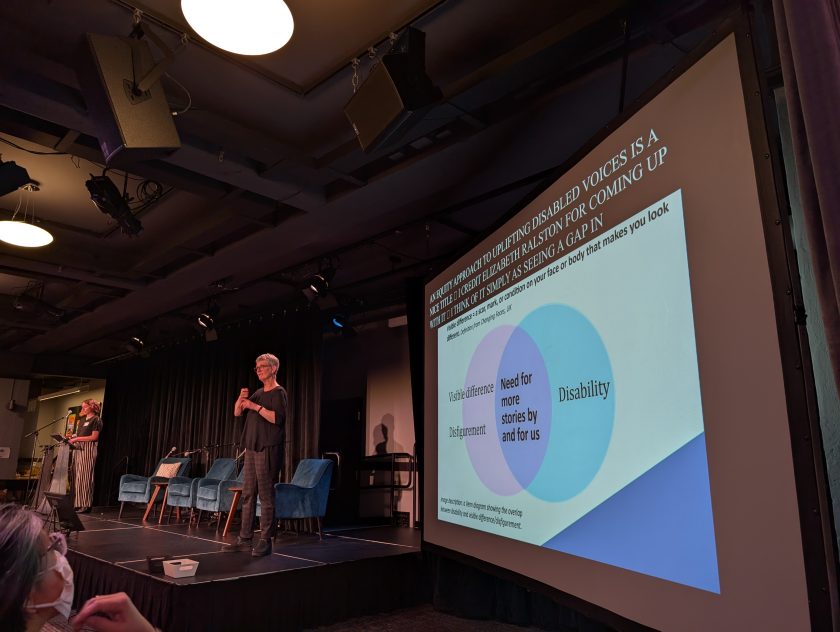
Grace shared her work as an oil painter and person with a visible burn scar. Her detailed interview and portraits of people with burn scars were beautiful and powerful. Her process includes making prints from burn scars which she also offers as a workshop in Seattle.
Her big take point was well captured by the early slide that people with visible differences need more visibility in cultural spaces. Her work is one fabulous contribution to doing that.
Chatting with Attendees
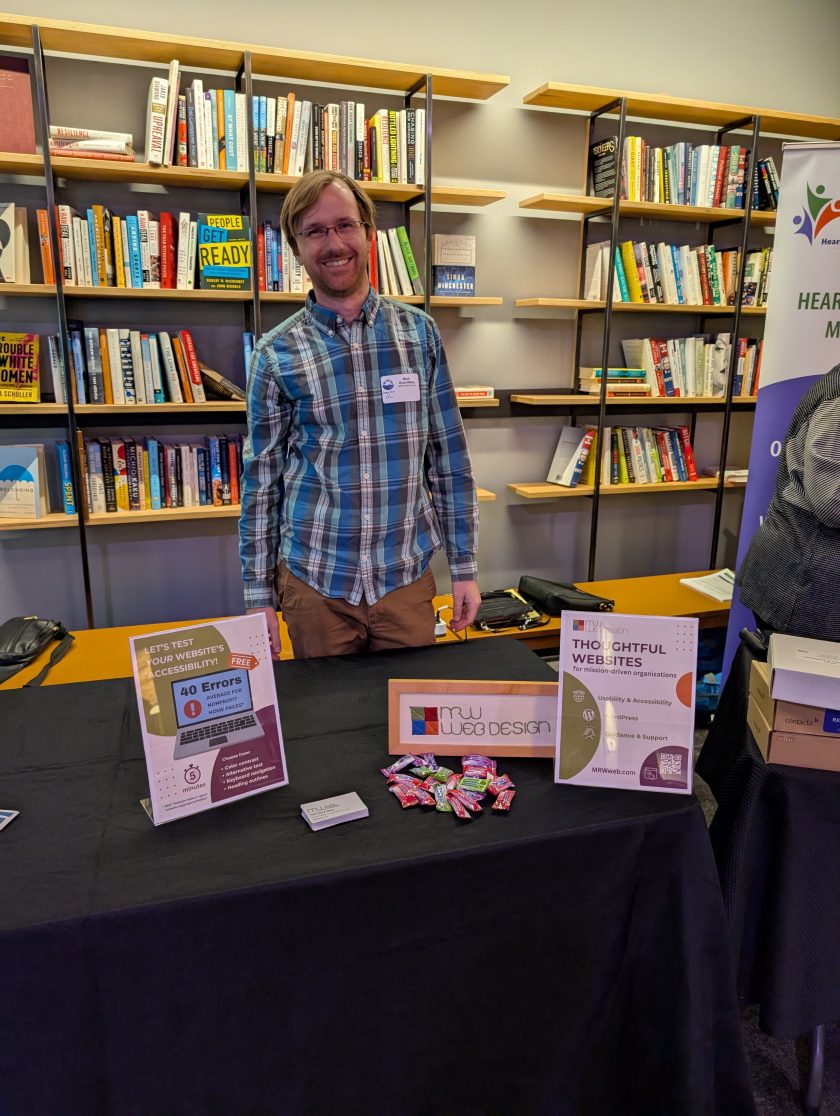
As a sponsor, I had some great conversations with folks! I was a little bummed that nobody took me up on the offer of a free 5-minute accessibility test, but there’s always next time!
- The difficulty of finding work in today’s job market and the sad lack of accessibility-focused roles in marketing
- The struggle to find website providers that prioritize web accessibility from the start of a project, and the difficulty of knowing whether your site is accessible or not.
- Resources for learning about alt text including beginner resources like the alt text decision tree and advanced sources like Cooper-Hewitt’s Guidelines for image descriptions for cultural organizations.
- The issues surrounding image descriptions for staff headshots including identity and representation. Having people write their own image description is a great way to introduce web accessibility across an organization.
- The value of visible image descriptions as opposed to alternative text for some people. (This one really challenged some of my assumptions and practices, and I am so grateful for the person who shared that with me and allowed me to ask a few follow ups. Accessibility is so personal—which should never come as a surprise, of course—and working to accommodate each individual in the way they prefer is a lifelong journey and goal.)
Unfortunately at this point, responsibility called and I had to take off to pick up the kids from school and go to soccer practice. I left this event feeling energized from spending so much time in a welcoming space with values-aligned people, and I hope I’ll be able to go again next year!
Mark! We were in the same place at the same time and I didn’t get a chance to introduce myself directly. Have followed your work since we both left Grinnell (class of 2006). Thank you for supporting SCAC (I’m on the committee) and for this amazing write up. This journey in making events and cultural offerings accessible needs advocates and supporters like you.
Margaret! Wow. What a small world. Thank you so much for reaching out and sharing your involvement with SCAC. I hope you’re all feeling great about the event. It really was wonderful.