I spent today at the Seattle Central Public Library listening and learning at the King County Digital Equity Learning Network 2025 Gathering for Access & Equity.
As we got started, the person delivering welcoming words immediately called out the sad reality that in a town known for technology, we still have elders, students, and adults without consistent access to good working devices and internet connections.
I’ve had clients for years working in this space, and I even interned in a digital equity focused organization in Washington D.C. during a summer in college (RIP, Byte Back). So I’m looking forward to sharing notes about what I learned throughout the day!
For anyone not familiar with my event field notes, they’re very much paraphrased unless directly quoted and more about interesting nuggets and my own reflections rather than exhaustive summaries.
Keynote: Darryl Hunt, “The Evolution of Digital Equity”
King County IT
The start of the pandemic really changed and accelerated how we work to increase technology access. It meant more organizations need to partner and work together.
But there’s lots more to do still, such as adding more low-cost internet plans (and not only using low introductory pricing).
To go farther, we need more coalitions and partnerships. As I saw the on the back of one attendee’s hoodie:
If you want to go fast, go alone. If you want to go far, go together.
Mr. Hunt asked the room who has used AI for work, and I was interested to see only about half the room raise their hands.
Sidebar on AI
I use a very small amount of AI in my coding work (usually the length of half a line of code), and I have a number of ethical concerns around the use of AI at all in addition to how it’s used. Clearly many people in the room believe that helping people learn to use AI is a part of the work to increase digital equity. I believe we need to balance these with the environmental impact of AI and the risks of encouraging people to rely on and offload thinking and decision making to a technology that by design replicates the inequitable internet and society it’s trained on.
Finally, regardless of how people use AI themselves, I would argue that digital equity work must include fighting how AI is used against those with unequal access to technology in areas such as hiring and other algorithmic decision-making processes. Especially in this time of rising attacks on vulnerable populations, we must be careful about who we share data with and who we encourage to share their data with AI companies.
Legislative Address: Mia Gregerson
Representative 33rd Legislative District, Former SeaTac City Council Member
One early experience of noticing a need for equity in politics was seeing the difference between who showed up at city council meetings vs. who was most impacted by legislation.
Given the current issues with federal funding cuts, it’s important to “de-silo” equity work, especially when resources are thin and there might be a natural inclination to compete. Notably, when speaking with legislators, it’s important to highlight that digital equity impacts people across the state and not just people in cities or the Puget Sound region.
Among bills she’s sponsored was Washington’s Right to Repair law, signed this year! That is important for everyone, and it’s not just about small devices. It’s as much about farmers repairing their tractor’s and rural hospitals repairing their medical devices. Again, equity impacts everyone.

Breakout Session 1: We’re All Champions of Our Work
David Keyes, Digital Equity Activist and former City of Seattle employee
Question for the room: “What is a digital equity champion?”
- Someone always asking about technology access when doing their work in any field
- Raising awareness about huge gap in tech skills among different populations
- Being the voice in the room to make sure programs and services don’t exclude people with less technology access and skills
For me: Since I focus almost exclusively on delivering information on a device, how can I be a voice for equitable information access? I focus a lot of energy on making my websites accessible to all people with any device and internet connection. That’s one form of digital equity, but not the only one.
Digital equity impacts public health, safety, service delivery, etc. We must elevate lived experience of people with less access and skills.
An interesting piece of wisdom:
Don’t always talk from an open wound. Also talk from a scar.
National Digital Inclusion Alliance (DNIA) Digital Equity Toolkit
Panel: Digital Equity Partnerships at Work
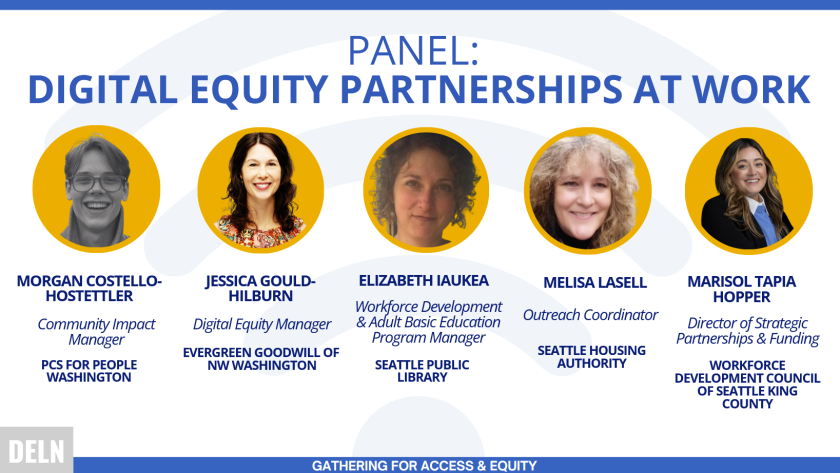
- Morgan Costell- Hostettler, Community Impact Manager, PCs for People Washington
- Jessica Gould-Hilburn, Digital Equity Manager, Evergreen Goodwill of NW Washington
- Elizabeth Iaukea, Workforce Development & Adult Basic Education Program Manager, Seattle Public Library
- Melisa Lasell, Outreach Coordinator, Seattle Housing Authority
- Marisol Tapia Hopper, Director of Strategic Partnerships & Funding, Workforce Development Council of Seattle King County
In discussing how partnerships work, I greatly appreciated the frequent reliance on other people’s and organization’s expertise. Folks with access to technology rely on community partners who know the populations they work with and serve, while other community organizations bring technology needs to their partners who can help provide solutions.
People know the supports they need. It’s on us to listen and try to meet people where they are—figuratively and literally!
A super cool community resource: The Evergreen Goodwill Digital Equity Bus
Another great resource: King County Digital Equity Asset Map
Breakout Session 2: AI and the Risk of Power Centralization
Changlin Li, Co-Founder, AI Safety Awareness Project
Interestingly, despite the show of hands earlier in the day, I seemed to be one of the most skeptical people in the room during this session. This is not the first time I’ve noticed a significant divide within a community over AI. I think there’s a lot of missing dialogue right now—everywhere, not just today—between folks primarily worried about the impacts of AI and folks who are excited about it.
This session in many ways felt more balanced than many discussions of AI I hear and see, but it still seemed to accept the baseline premise that AI is here and folks who don’t get on board will get left behind.
Post work: Spend 30 minutes afterwards thinking about and writing about an AI future I am hoping for.
One challenge with fast-moving technologies is not looking ahead to foresee shifts in technology beyond just “cheaper and faster.” Also want to avoid “technological determinism” and allowing tech to happen to us rather than for us. People deserve transparency and the chance to understand AI before it reshapes their daily lives.
Interesting definition of “artificial intelligence” as “mimicking aspects of human intelligence.” Which aspects is it mimicking? Which isn’t it? Is that by design or a “bug?”
Threats that AI is amplifying1:
- Phishing and spear-phishing
- Political influence / persuasion
- Harassment and hate mail
- Deepfakes and fake news
- Identity theft and fraud
Changlin’s “AI Safety” definition:
- Avoid making existing problems worse
- Manage unprecedented social and economic impact
- Make sure AI doesn’t endanger humanity
As the session wrapped up, we were asked what our communities need to have AI safety in the future. One attendee mentioned government regulation, while I expressed concerns around our cultures current uncritical acceptance and demand for tools without full consideration of their impacts or long-term drawbacks. See: “Social License to Operate”
As if my RSS reader was listening to me (which it isn’t because RSS is awesome), there were two great, relevant posts about AI in my feed on the bus ride home:
“Coattails” from Jeremy Keith:
It’s not just that the term “AI” isn’t useful, it’s so broad as to be actively duplicitous. While talking about one thing—like, say, large language models—you can point to a completely different thing—like, say, machine learning or computer vision—and claim that they’re basically the same because they’re both labelled “AI”.
Notably, I fail to make that distinction in this entire writeup because the discussions and presentations didn’t either.
“amac at UMass: How do we regulate AI?” from Ethan Zuckerman:
As someone not currently in the regulatory game, amac notes Lina Khan’s observation, “there is no AI exception” to existing laws on the books regarding hiring, housing or other forms of discrimination. amac suggests regulation should focus on real harms, not hypothetical or science fiction harms. Deepfakes are causing real, meaningful harm right now – that would be an excellent place to start.
Wrapping Up
Unfortunately, I had to miss the closing in order to get home and pick up the kids, but I’m glad I went to this event. I was able to connect with a couple people I knew, learn more about the Seattle landscape of organizations working toward digital equity, and spend valuable time thinking about how I incorporate digital equity into my own work.
It’s very clear to me that the DELN is a very valuable network, and that it has enabled a number of concrete new programs and partnerships to increase technology access. I hope they’re able to continue growing and facilitating more conversations like the ones they had today.
- This ties in perfectly to the Lina Khan quote mentioned toward the end of this post that “there is no AI exception” to existing laws on the books. ↩︎